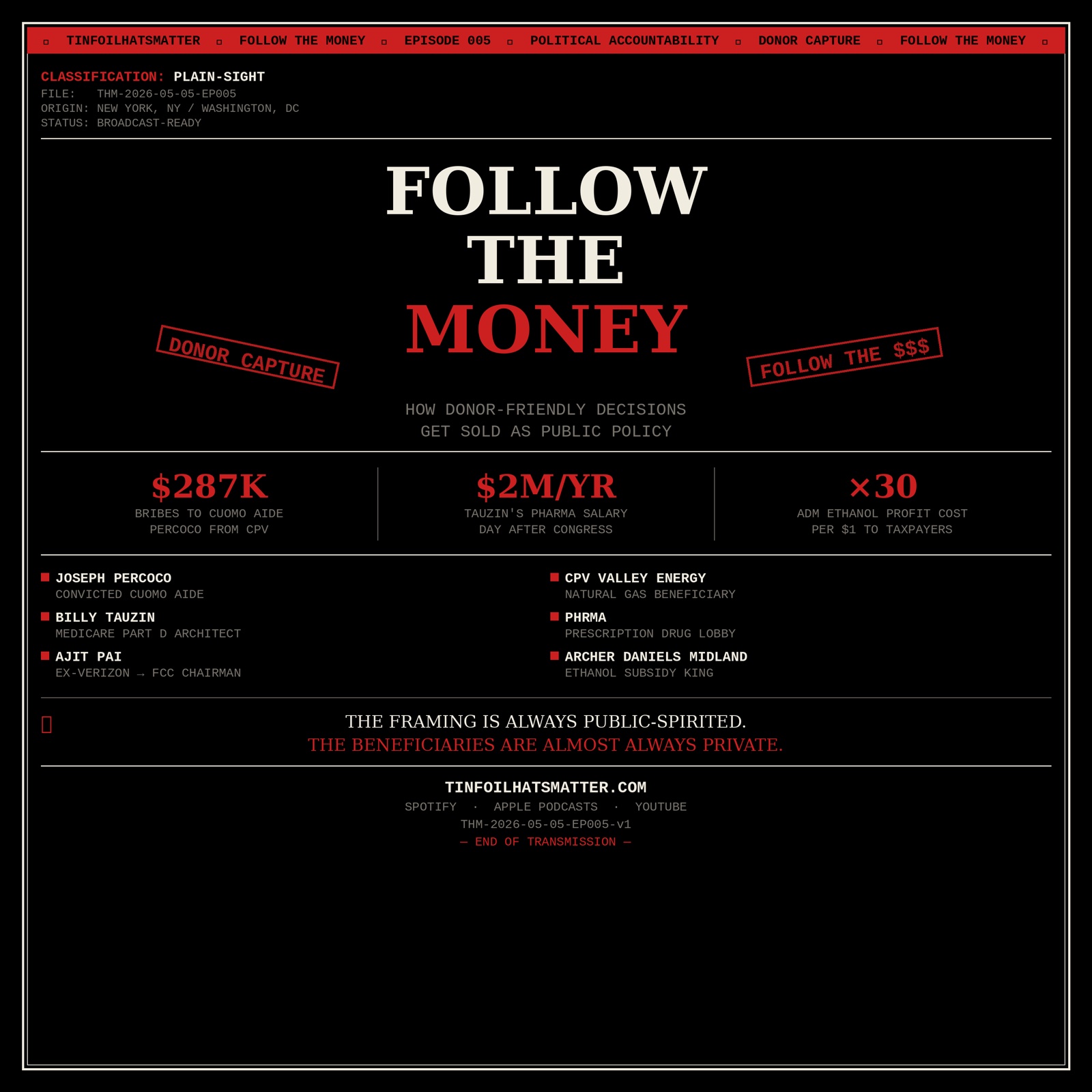
Follow the Money: How Donor-Friendly Decisions Get Sold as Public Policy
When the press release says 'public good' and the wire transfer says otherwise.
From the federally prosecuted bribery scheme behind Indian Point's closure to the congressman who wrote Medicare's drug pricing rules and became the pharma lobby's CEO the very next day, this episode maps the money trail behind decisions that looked like policy but functioned like payment. Covering Indian Point and CPV Valley Energy, Medicare Part D, the repeal of net neutrality, and four decades of corn ethanol subsidies, the pattern is identical every time: a public-interest justification, a private-interest beneficiary, and a donor who will not be named at the press conference.
Loading tally…
Cold open
Let me tell you about a decision so spectacularly short-sighted that the same people who made it are now, with a completely straight face, doing the opposite thing — and expecting nobody to notice.
But before I get to that, I want to talk about a pattern. Because what happened in New York is not some isolated incident of garden-variety political incompetence. It is one tile in a very large, very expensive mosaic. A mosaic that, when you step back and look at the whole thing, depicts the same scene over and over again: a politician making what looks like a dumb decision, some ordinary people losing money and services they depended on, and somewhere just off to the side of the frame — almost out of view — a donor smiling.
This is the story of who really wins when politicians do something that makes no sense. And I promise you, by the end of this, you will never look at a press conference the same way again.
Let's start local, and then we'll take this national, because the national version is somehow even worse.
The Indian Point bribe
Indian Point Energy Center. A nuclear power plant sitting on the Hudson River, about 35 miles north of New York City. For decades, it quietly generated a quarter of New York City's electricity. Clean electricity. Carbon-free electricity. The kind of electricity that just works — whether it's July and every air conditioner in the five boroughs is running at full scream, or February and the grid is being held together with prayers and antifreeze.
In 2017, then-Governor Andrew Cuomo announced it was time for Indian Point to go. The official story was safety. Tritium leaks. Proximity to the city. The general anxiety that comes with having a reactor near one of the densest population centers on Earth. And look, some of those concerns are real. Being nervous about a nuclear plant 35 miles from Manhattan is not insane. I get it.
But here is the thing they very much did not put in the press release.
While Cuomo's office was publicly performing concern about reactor safety, federal prosecutors were quietly documenting a completely different conversation happening in private. Competitive Power Ventures — CPV — was a company planning to build a natural gas plant in Orange County, New York. A 680-megawatt fracked-gas plant that, conveniently, would need a market once Indian Point was gone. CPV donated $75,000 to Cuomo in 2009. Then, starting in 2010, they did something a little more direct. They arranged a job for the wife of Joseph Percoco — one of Cuomo's closest aides, a man described as being like a son to him — at a salary of $90,000 a year. For work that wasn't entirely clear. Federal prosecutors later described this as a low-show job. CPV's own executive eventually pleaded guilty to arranging it. The payments to Percoco's household totaled nearly $287,000.
What did CPV get in return? According to the U.S. Attorney's office, they got Percoco working the levers of state government on their behalf — including, specifically, advocacy for closing Indian Point. The indictment states that the importance of the CPV plant to the state "depended at least in part on whether Indian Point was going to be shut down." Percoco was convicted in 2018. The CPV plant is running today, burning fracked natural gas, pumping carbon into the atmosphere, and charging New Yorkers for the privilege.
So the sequence was: nuclear plant gets closed on safety grounds, natural gas plant gets built by a company that paid bribes to a Cuomo aide to make that happen, and electricity prices and carbon emissions both went up. The bribery scheme worked. It worked completely. The only people it didn't work for were the people who pay electric bills in New York.
And now, just a few years later, Governor Kathy Hochul — who carried forward Cuomo's energy agenda — has announced that New York is going to build a new nuclear power plant. Because, as it turns out, the grid needs reliable, carbon-free power. Which is exactly what Indian Point was providing. Before someone got paid $287,000 in what prosecutors described as "ziti" to help get rid of it.
You genuinely cannot make this stuff up. And yet, here we are.
But I promised you national examples. So let's zoom out, because what happened in New York is just a local production of a show that's been running in Washington for decades.
Tauzin and the Medicare giveaway
Let me tell you about Billy Tauzin. If you don't know this name, you should. Tauzin was a congressman from Louisiana, and then he was chairman of the House Energy and Commerce Committee — the committee that has jurisdiction over, among other things, the pharmaceutical industry. In 2003, Tauzin was the primary architect of Medicare Part D, the prescription drug benefit program. On the surface, this sounds great. Seniors getting help with drug costs. What could be wrong with that?
Here's what was wrong with it: buried in the legislation was a specific, explicit prohibition on Medicare negotiating drug prices with pharmaceutical companies. The government — the single largest buyer of prescription drugs in the country — was legally banned from asking for a bulk discount. Every other federal program could negotiate. The Veterans Administration negotiates and pays dramatically less for the same drugs. But Medicare? Forbidden. By law. A law Billy Tauzin helped write.
The pharmaceutical industry loved this, for reasons that require approximately zero explanation.
Now, here's where it gets elegant in its shamelessness. A few months after Medicare Part D passed, Tauzin announced he was retiring from Congress. The day after his term ended — literally the next day — he was announced as the new president and CEO of PhRMA. The pharmaceutical industry's main lobbying organization. At a reported salary of $2 million a year. Later documents showed he received $11.6 million in a single year and eventually cashed out for a cool $11.6 million package.
There were rules against this kind of thing. After the backlash, Congress updated those rules, specifically because of what Tauzin did. But here's the detail that makes your eye twitch: multiple reports noted that Tauzin may have been negotiating the PhRMA job while he was still writing the Medicare legislation that benefited PhRMA. He didn't even try to be subtle about it. It wasn't a wink and a nod. It was a full, extended, choreographed bow.
And the cost to ordinary Americans? Seniors on Medicare pay dramatically more for prescriptions than people in every other developed country. The VA pays a fraction of what Medicare pays for identical drugs. One analysis estimated that if Medicare paid VA prices, it would save hundreds of billions of dollars over a decade. That gap — that enormous, completely unnecessary, legally mandated gap — is the legacy of one committee chairman and one very lucrative revolving door. Every American who has ever rationed medication because they couldn't afford the full prescription is, in some small way, paying for Billy Tauzin's retirement package.
And by the way — at least 15 congressional staffers and officials who worked on Medicare Part D subsequently took jobs in the pharmaceutical industry. This wasn't a one-person operation. It was a career pipeline. Write the law that protects the industry, then go get paid by the industry. Collect your ziti at every stage.
Ajit Pai and the Verizon door
Now let's talk about the internet. Specifically, let's talk about why your internet bill is what it is and why your provider can do basically whatever it wants to your connection speed.
Ajit Pai. Remember that name. In January 2017, he became the chairman of the Federal Communications Commission, appointed by President Trump. And in December of that year, despite 22 million public comments — 22 million people taking the time to formally register an opinion with a federal agency, which is not something people do for fun — the FCC voted along party lines to repeal net neutrality protections.
Net neutrality, for those who have successfully suppressed the memory, was the rule that said internet service providers had to treat all internet traffic equally. They couldn't throttle your Netflix to sell you a faster lane. They couldn't charge websites extra to reach you at full speed. The internet had to be a level playing field. Gone. Repealed. At the express request of the telecom industry.
Here's the part you need to know about Ajit Pai: before he was FCC chairman, he was a lawyer for Verizon. That's not an accusation — that's his resume. He worked as an in-house lawyer for Verizon Communications, handling regulatory issues and broadband policy. Then he went to the FCC. Then, as FCC chairman, he killed the regulations that Verizon had spent years fighting against. Then he left the FCC.
Comcast, Verizon, and AT&T collectively spent hundreds of millions lobbying against net neutrality. They funneled millions in campaign donations to members of Congress on both sides of the aisle — AT&T donors gave money to 88 percent of House members, which is a number that should make everyone deeply uncomfortable. They got what they paid for.
And what did you get? Well, within months of the repeal taking effect, providers were already caught throttling traffic. Verizon throttled video streaming during a California wildfire emergency, limiting the bandwidth of first responders using their data plan. Your internet got more expensive. Rural Americans fell further behind on broadband access. And prison phone companies — which were also supposed to be regulated by the FCC but got deregulated under Pai's tenure — continued charging inmates and their families rates that can only be described as extortion.
Ajit Pai genuinely filmed a holiday video making fun of people who said he was a Verizon shill. While being a former Verizon lawyer who was in the process of doing exactly what Verizon wanted. The audacity is, in its own way, almost impressive.
ADM: half a century of bipartisan extraction
But my personal favorite example — my absolute, ride-or-die, showcase example of a company that has spent half a century turning political donations into federal mandates — is Archer Daniels Midland. ADM. Known by critics as the most prominent recipient of corporate welfare in American history, which is a competition with very stiff entrants.
ADM is a massive agricultural processing company based in Decatur, Illinois. They process corn, soybeans, wheat. They make high-fructose corn syrup. And they make ethanol — corn-based fuel that gets blended into your gasoline. Here's the thing about corn ethanol: it is, by nearly every independent analysis, a terrible idea. The energy you get from burning it is barely more than the energy required to produce it. It doesn't meaningfully reduce greenhouse gas emissions when you account for how much energy goes into growing and processing the corn. It drives up food prices because you're using corn for fuel instead of food. And yet it has been mandatory — a legal requirement — to blend it into American gasoline for decades, backed by billions in federal subsidies.
How did that happen?
Dwayne Andreas, the longtime CEO of ADM, is described by some observers as arguably the most generous and influential political donor of the second half of the 20th century. He gave money to Nixon — including, it emerged during Watergate, a $25,000 check that ended up funding the Watergate break-in. He gave money to Carter. He gave money to both sides, all the time, lavishly. In return, ADM received federal subsidies, ethanol mandates, import protections for sugar that conveniently benefited ADM's corn syrup business, and export programs that guaranteed markets for ADM's grain. A Cato Institute analysis found that at least 43 percent of ADM's annual profits came from products that were either subsidized or protected by the government. Every dollar of profit from ADM's ethanol operation cost taxpayers $30.
Thirty dollars out of your pocket for every dollar into theirs. And that arrangement was built, maintained, and defended over decades through donations to both parties, in every election, through every administration, regardless of who was in the White House. Because ADM understood something fundamental: it doesn't matter which party wins if you've already bought people in both.
When corn prices spiked dramatically in the mid-2000s partly because of ethanol mandates diverting food corn into fuel production, global food prices went up. People in developing countries faced higher food costs. In the United States, your grocery bill got more expensive. And ADM continued making money.
The pattern
So here's the pattern, because I want to be clear about what connects Indian Point to Billy Tauzin to Ajit Pai to Archer Daniels Midland. It is not a conspiracy. It does not require a secret room or a handshake. It is something much more mundane and therefore much more durable.
Politicians need money to run campaigns. Companies have money. Companies want favorable policies. Politicians write policies. You can see where this goes.
The transaction doesn't have to be corrupt in the Percoco sense — the literal briefcase of cash, the low-show job, the "ziti." Most of the time it's totally legal. You donate to campaigns. You hire former staffers as lobbyists. You give speeches at industry conferences. You offer a former regulator a board seat. And in return, the people making policy decisions have, at the very least, excellent reasons to see your side of every argument. They're embedded in your world. Your lawyers write the first drafts of the rules. Your people staff the agencies. The revolving door spins and spins and spins.
And meanwhile, on the other side of the transaction — the side that doesn't have lobbyists or PACs or board seats to offer — is everyone else. The New Yorker whose electric bill went up after Indian Point closed. The senior who has to choose between prescriptions because Medicare can't negotiate prices. The person in a rural area who's paying monopoly prices for slow internet because competition was never enforced. The family whose grocery bill ticked up because corn that could have been food is being blended into gasoline so a corporation in Decatur, Illinois can cash a subsidy check.
They don't get a revolving door. They get the consequences.
And the really special part — the part that makes this whole thing so durable — is that it's almost never presented as what it is. It's presented as safety. As innovation. As protecting the environment. As modernizing the grid. As growing the economy. The framing is always public-spirited. The beneficiaries are almost always private.
The close
The question you should be asking about every major policy decision — not just in energy, not just in healthcare, not just in telecom — is: who specifically wins when this happens? Not in the abstract. Not "the market" or "consumers" or "innovation." Who, specifically, is depositing a check tomorrow because of what got decided today?
Because somewhere, there is always someone depositing a check.
The question is just whether you know who it is before or after you pay the price for the decision they funded.
Indian Point is still being decommissioned. New York is still paying more for electricity. The CPV gas plant is still running on fracked gas from Pennsylvania. And somewhere in Albany, people are earnestly announcing plans for a new nuclear plant, as if none of this ever happened.
The meter is still running. As always, you're the one paying it.
Full source list and citations in the dead drop newsletter.