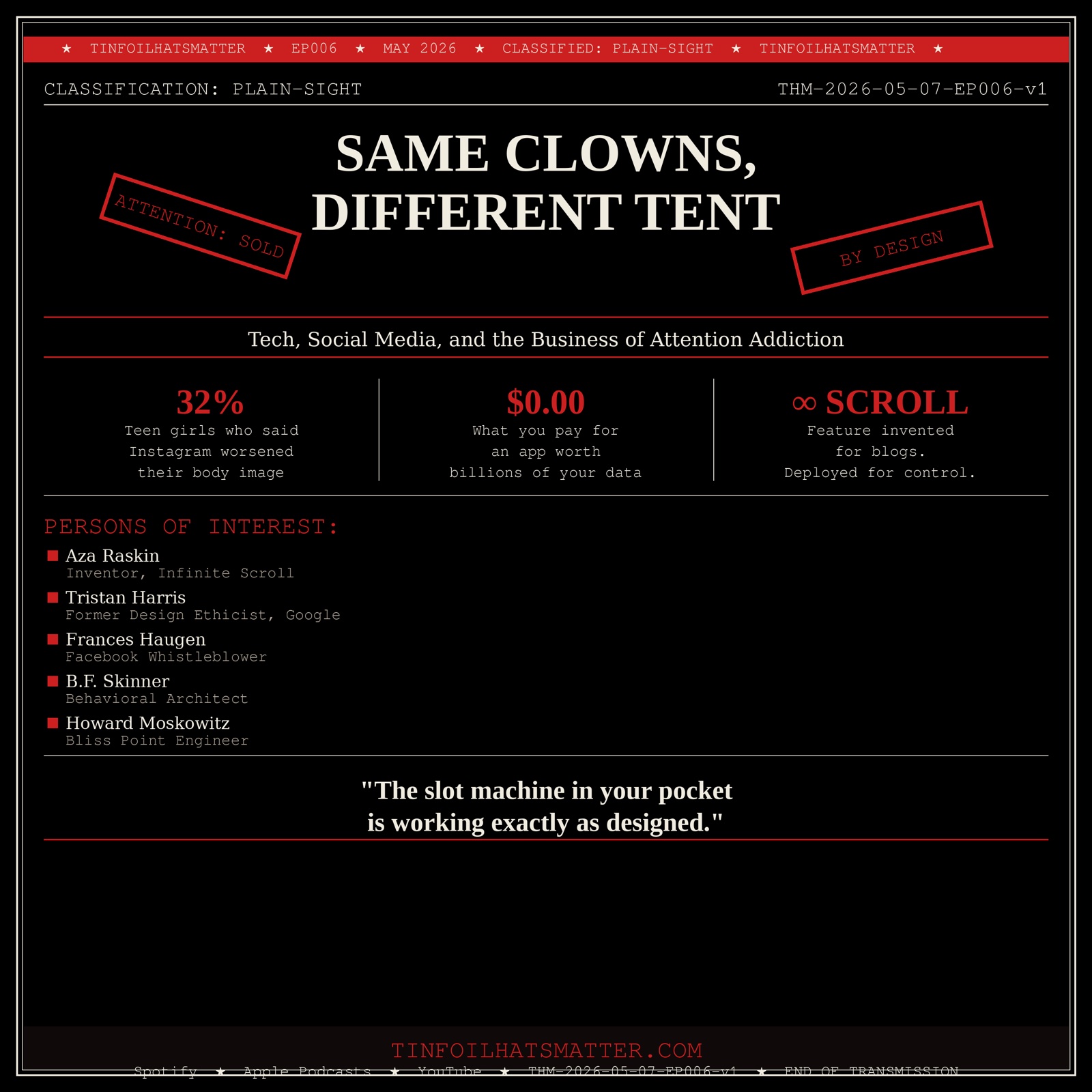
Same Clowns, Different Tent
Tech, Social Media, and the Business of Attention Addiction
In 2006, a software designer built infinite scroll to fix a pagination annoyance. Two decades later, he calls it "behavioral cocaine." This episode traces how tech companies borrowed the playbook from tobacco and processed food — variable reinforcement, engineered compulsion, internal research documenting harm — and built something worse: a dependency you can't quit because they made it load-bearing infrastructure for modern life. Three industries. Three timelines. The same defense. The same delay. Same clowns, different tent.
Loading tally…
Cold open
Let me tell you about a man named Aza Raskin.
It's 2006. Aza is a software designer working at Mozilla — you know, the browser company that everyone installs and then immediately forgets about. And he's annoyed. Genuinely, personally annoyed. Not at the state of the world, not at corporate greed, not at the surveillance economy quietly metastasizing around him. No. He's annoyed because Google makes you click to go to the next page of results.
The audacity.
Page 2. Like a peasant.
So Aza — who is, by all accounts, very smart and very well-intentioned — has a thought. What if when you reached the bottom of a page, it just… kept going? What if content loaded automatically, infinitely, forever, with no natural stopping point, no moment to breathe, no prompt to ask yourself whether you actually needed to be here? What a gift to humanity. What a seamless user experience. What a totally-not-catastrophic idea.
He built it. He called it infinite scroll. He showed it to Twitter and Google and said, "Hey, you should use this." And he was right — they absolutely should have, if their goal was to trap human consciousness in a frictionless loop of content consumption until the heat death of the universe.
Which, it turns out, it was.
Aza Raskin has since called his own invention "behavioral cocaine." He's testified in court about it. He's gone on podcasts to apologize. He said — and I'm paraphrasing, but only barely — that the problem was he built something for ease of use without thinking about whether ease of use was actually good for anyone. And he wasn't wrong. He was designing for blog posts. He was thinking about search results. He was not thinking about what happens when you hand that same feature to a company whose entire business model depends on you never, ever leaving.
That's the story of how we got here. A frustrated engineer, a pagination problem, and about two decades of compulsive scrolling.
But here's the thing: Aza Raskin is not the villain. He's more like the guy who invented the shotgun and then watched someone else invent buckshot. The mechanism was neutral. The application was not.
So let's talk about the application.
Selling you, in real time
At some point in the last twenty years, we collectively decided to hand over the most valuable thing we have — our attention — to companies whose business model is selling it to strangers.
Let's just sit with that for a second.
You go to Instagram. You don't pay anything. You scroll for forty-five minutes. A clothing brand pays Instagram to show you an ad during minute thirty-two because Instagram knows — based on your behavior — that you're a 34-year-old who looked at hiking boots last Tuesday, that you tend to engage with outdoor content between 9 and 11pm, and that you respond better to aspirational imagery than to price-focused ads. That brand didn't buy ad space. They bought you. Specifically, a sliced and packaged version of you, auctioned in real time to the highest bidder.
This is not a conspiracy theory. This is the quarterly earnings call.
Engagement is the spec
Meta, Google, TikTok — these companies compete on exactly one primary metric, and it is not "did our users feel good today." It's engagement. Time on platform. The longer you stay, the more data is generated. The more data generated, the more precisely behavior can be predicted. The more precisely behavior can be predicted, the more advertisers will pay. It's a loop. A beautiful, efficient, terrifying loop.
And here's where it gets genuinely interesting — or genuinely disturbing, depending on your mood — because this business model has a very specific design implication. If your revenue is a function of engagement, then every design decision you make has to answer one question: does this keep people here longer? Not: does this make people happier? Not: does this make people healthier? Not: is this true? Just: does it keep them here?
That's not a bug. That's the spec.
The blueprint: Skinner, tobacco, food
Now, none of this would work if the companies had to figure out human psychology from scratch. Lucky for them, they didn't have to.
The blueprint already existed.
B.F. Skinner — psychologist, behaviorist, man who once raised his infant daughter in a box, which is a whole other podcast — figured out in the 1950s that the most effective way to create a persistent behavioral habit is through what he called variable ratio reinforcement. Which is a very academic way of saying: reward people sometimes, unpredictably, and they will keep doing the thing forever. Reward them every time? They'll stop caring. Reward them never? They'll stop trying. But reward them sometimes, with no predictable pattern? Congratulations, you've built a slot machine. You've built compulsion.
Tobacco companies understood this. Not the Skinner part — they weren't that sophisticated — but they understood that nicotine hit a reward circuit, and that if you could get someone to use a product often enough, the product started doing the marketing for you. The brain would demand it.
Food companies went a step further. A researcher named Howard Moskowitz — who I would describe as either a genius or a monster, possibly both — spent decades working for companies like Campbell Soup and Pepsi to figure out the precise mathematical point at which a food product becomes maximally irresistible. He called it the "bliss point." The exact ratio of sugar, salt, and fat at which a human will keep eating past the point of hunger, past the point of fullness, past the point of any rational decision-making whatsoever. He didn't just find the bliss point for one product. He found it for hundreds. And the industry deployed it everywhere.
Tech companies looked at all of this and thought: we can do that, but faster, cheaper, and at a scale that makes the cigarette industry look like a lemonade stand.
Variable reward? That's the notification. Sometimes it's something interesting. Sometimes it's garbage. You check anyway, because your brain cannot resist the slot machine.
No stopping cues? That's infinite scroll. Thanks, Aza.
Social validation spikes? That's the like button. Someone, somewhere, approved of you. For a moment. Maybe. Better check.
Algorithms that learn what triggers the strongest response and then serve you more of it? That's the whole thing. That's the entire thing.
Tristan Harris and the brain stem
In 2016, a man named Tristan Harris left his job as a design ethicist at Google and started telling anyone who would listen that the tech industry was deliberately engineering compulsive behavior into its products.
Harris had worked on what Google called "persuasive technology" — systems designed to influence user behavior through design choices rather than explicit persuasion. And his argument, which he made in front of Congress, in a Netflix documentary, on every podcast that would have him, was simple: these platforms are not neutral tools. They are behavioral modification systems, and the behavior they're modifying you toward is the behavior that serves their business model.
He put it bluntly. He said tech companies were "hacking the brain stem."
Now, tech companies did not love this framing. Their preferred framing was — and remains — "we give people what they want." It's a clean defense. It's also the same defense the tobacco industry used when it said "people choose to smoke," and the same defense the food industry used when it said "people choose what they eat." And it has the same flaw: it assumes that "what people want" is a pre-existing condition that the industry is simply meeting, rather than something the industry is actively shaping.
When an algorithm learns that outrage drives more engagement than nuance — and it has learned this, repeatedly, because it's been tested — and then serves you more outrage, it is not reflecting your preferences. It is creating them. When a feed is designed so that the most inflammatory content spreads fastest because inflammatory content generates the most reactions, and reactions are how the algorithm measures value, that's not personalization. That's amplification of whatever makes you least likely to close the app.
And here's the part that separates tech from tobacco and food: they can measure the results in real time, and they can iterate on them in hours.
The Facebook Files
In the fall of 2021, a former Facebook data scientist named Frances Haugen walked out of her job with tens of thousands of pages of internal company documents and handed them to the Wall Street Journal.
What followed was called The Facebook Files. And it was bad.
Not bad in a surprising way — more bad in a "so they did know" way.
The documents showed that Facebook's own internal research had found that Instagram was making things worse for a significant number of teenage girls. Worse body image. Worse mental health. One internal study found that 32% of teen girls who already felt bad about their bodies said Instagram made those feelings worse. Another found associations with increased rates of anxiety and depression among younger users. Facebook had this research. Facebook's executives had seen this research. And Facebook had, at various points, discussed — and in some cases, shelved — design changes that might have addressed it.
Now, to be fair — and I'm going to be fair because being fair is how you stay credible — the statistical methodology behind some of these numbers has been critiqued. NPR, among others, pointed out that some of the most widely reported figures came from subset samples, not random populations, and that the framing of the data in the leaked slides was not always rigorous. The numbers were real, but they required context that didn't always make it into headlines.
Which is exactly the kind of nuance that feels less interesting until you realize it's how we end up arguing about methodology instead of the central, undisputed finding: Facebook knew its products were causing harm to vulnerable users, and they kept optimizing for engagement anyway.
Because engagement was the metric. And the metric doesn't care about the collateral.
Three industries, one script
Here's the thing I need you to hold onto.
Three industries. Three timelines. Three almost identical scripts.
Tobacco: Industry funds research that disputes its own private findings. Internal documents show they knew nicotine was addictive. Public statements deny it. Regulation arrives decades late.
Food: Industry funds research suggesting ultra-processed food is fine, actually. Internal R&D is specifically designed to override satiety signals. Public messaging blames individual consumers for lacking willpower. Regulation arrives, mostly in the form of labels nobody reads.
Tech: Internal research documents harm, particularly to younger users. Public statements emphasize user empowerment and safety tools. Regulation is introduced amid fierce lobbying. The metric remains engagement.
Same playbook. Different tent.
And I want to be clear about something, because this is the part where it would be easy to slide into "these executives are evil geniuses who stay up at night cackling about dopamine." That's not quite right. The more uncomfortable truth is that most of these decisions aren't made by mustache-twirling villains. They're made by product managers hitting quarterly targets. By designers optimizing metrics. By algorithms that nobody is directly supervising, improving themselves based on what keeps users on the platform.
The harm doesn't require malice. It just requires a misaligned incentive, applied consistently, at scale, over a long period of time.
That's what makes it hard to fix.
Why you can't quit
You can quit smoking. People do it every day. It's awful and it takes multiple attempts and there's an entire pharmaceutical industry built around helping you do it, but it's structurally possible to remove tobacco from your life. You can change your diet. It's hard, it requires resources not everyone has, but you can eat differently. The product exists in a separate category from your daily function.
You cannot opt out of tech.
This is not a metaphor. Your job almost certainly requires it. Your kids' schools communicate through it. Your government services are accessed through it. Your social relationships are, to a meaningful degree, mediated by it. And the same companies that designed these platforms for compulsive engagement have made those platforms load-bearing infrastructure for modern life.
So when someone tells you to "just use it less," they are making a suggestion that is roughly equivalent to telling someone in a food desert to "just eat healthier." Technically accurate. Structurally ignoring the problem.
And this is before we get to the social cost. When everyone around you is on Instagram, not being on Instagram has a real cost. You miss things. You're excluded from conversations. You're invisible in spaces where visibility matters. The social enforcement of these platforms is part of the design, whether intentionally or not. Network effects are just another word for "leaving is expensive."
This is the most powerful version of the dependency loop any of these industries has ever built. Tobacco made you chemically dependent. Food made you calorically dependent. Tech made you socially dependent. And social dependency is the one where opting out carries consequences that extend beyond yourself.
The close
Here's where I land on this.
None of this is about demonizing the engineers who built these things — many of whom, like Aza Raskin, have spent considerable energy since trying to undo the damage. None of this is about saying technology is inherently bad, or that social media has no value, or that we'd all be better off writing letters with a fountain pen. There's genuine good in these platforms. Connection, community, access to information, creative expression — it's real.
But there is a pattern, and the pattern is this: when an industry's profit depends on dependency, design will always follow the incentive rather than the ethics. Not because the people are bad. Because the system rewards the behavior and punishes the alternative.
Attention addiction is not a moral failing. It is a predictable outcome of systems that were optimized — deliberately, measurably, continuously — for engagement.
The slot machine in your pocket is working exactly as designed.
The question is who designed it, for what purpose, and whether we're going to keep pretending that's the same thing as what you actually want.
Until we have regulatory frameworks that treat attention as something worth protecting — the way we (eventually, after many deaths) treated lungs and arteries — and until there are business models that can profit from your wellbeing instead of your compulsion, this is where we are.
Full source list and citations in the dead drop newsletter.