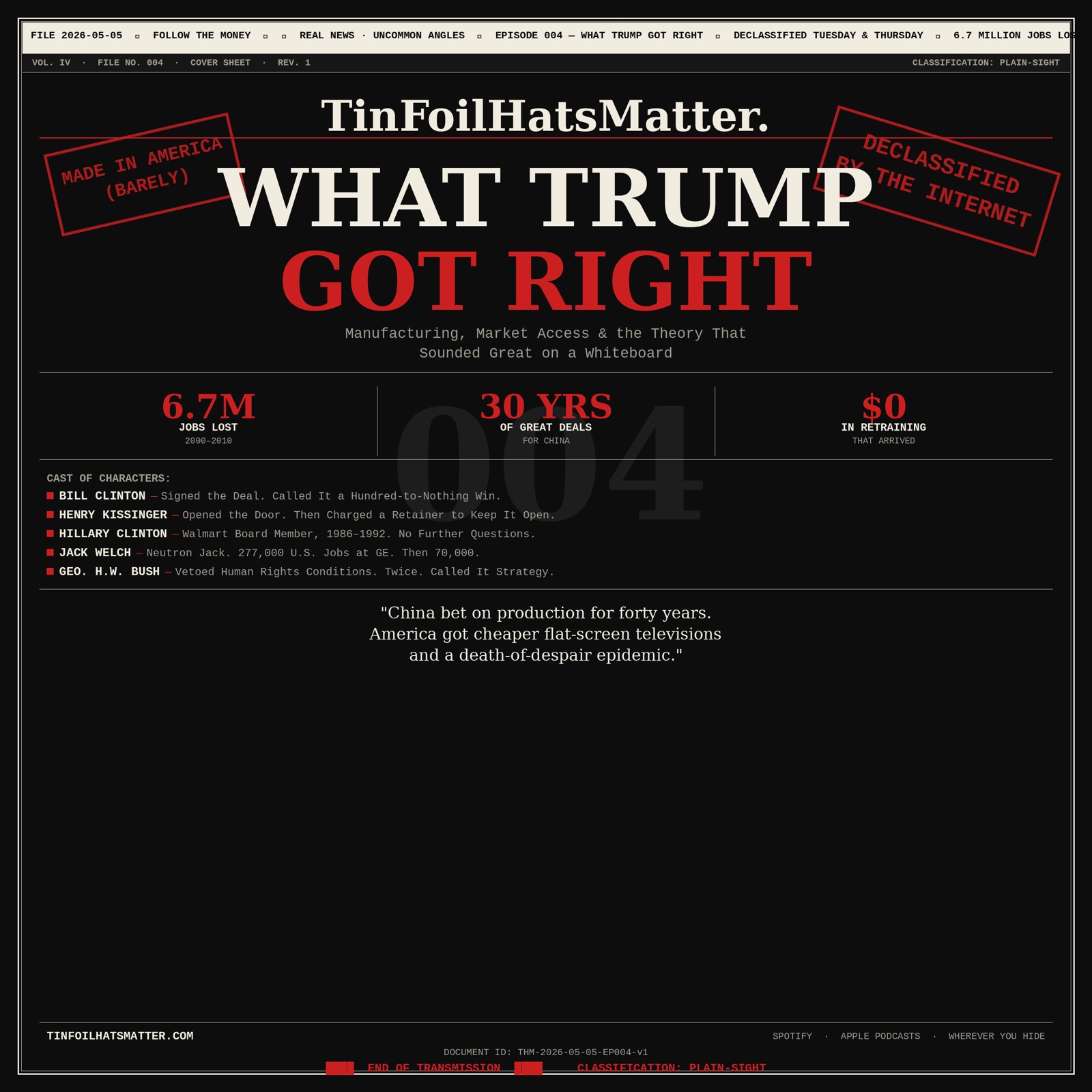
What Trump Got Right
Manufacturing, Market Access & the Theory That Sounded Great on a Whiteboard
For thirty years, the people who designed America's trade policy promised that offshoring manufacturing would lead to better jobs, a stronger economy, and a more democratic China. They were wrong on all three counts — and the bill came due in hollowed-out factory towns, a technology transfer that can't be undone, and a death-of-despair epidemic in the exact zip codes where the plants used to be. This episode names the names: Kissinger, both Clintons, Jack Welch, and the bipartisan consensus that called it sophistication while the workers called it the end.
Loading tally…
Cold open
Let's say something that will immediately make everyone uncomfortable.
Donald Trump got something right.
Not everything. Calm down. This is not a hostage video filmed at Mar-a-Lago. Nobody is holding a gun to my head. I have not been compromised. The tin foil is intact. But on one specific issue — one issue that the polite, bipartisan priesthood of economists, consultants, lobbyists, and cable-news forehead-havers spent thirty years pretending wasn't real — the man hit a nerve.
Manufacturing matters.
Not because every American needs to spend forty years tightening bolts. Not because the nineteen-fifties are coming back. Not because nostalgia is an industrial policy — it isn't, and anyone who tells you it is should be handed a Hallmark movie and gently escorted from the conversation.
Manufacturing matters because countries that make things retain power. Countries that make things retain skills. Countries that make things retain supply chains, engineering know-how, bargaining leverage, and a middle class that doesn't have to learn Python at age fifty-two because some consultant in a Patagonia vest decided their job had — and I am quoting an actual category of corporate euphemism here — "migrated to a more efficient labor market."
That's a real phrase. Real people said it. With straight faces. To other real people whose entire towns were in the process of disappearing.
And we know who said it. That's the thing. This was not some anonymous market force. This was not an act of God. This was a series of specific decisions made by specific people who had names, held offices, collected fees, sat on boards, and — in several remarkable cases — managed to profit personally from the arrangements they were publicly championing.
So today we're going to name names.
We're going to start at the very beginning, which, like most American foreign policy disasters, involves Henry Kissinger.
Kissinger opens the door — then bills for the next forty years
The year is 1972. Richard Nixon flies to Beijing.
It is, genuinely, a historic moment. The United States and the People's Republic of China, after more than two decades of near-total hostility, are reestablishing contact. Nixon shakes Mao Zedong's hand. There are photographs. The geopolitical logic at the time is real: triangulate China against the Soviet Union, create a strategic wedge, complicate Moscow's options. Fine. In the Cold War context, that part makes sense.
What happened next is where it gets interesting.
Henry Kissinger, Nixon's National Security Advisor and the architect of the China opening, did not stop doing China business when he left government. In 1982, he founded a consulting firm — Kissinger Associates — and spent the next four decades advising multinational corporations on how to navigate business in the country he had opened to the West.
Let that sit for just a moment.
The man who personally opened China to American commerce then built a private business helping American corporations deepen their ties to China. His firm reportedly charged clients over two hundred thousand dollars a year in annual fees. His client list was famously secret — the firm threatened to sue Congress to resist a subpoena for it. But known clients over the years included American Express, Coca-Cola, H.J. Heinz, ITT, and Fiat. He also separately ran a China-focused joint venture investment vehicle called China Ventures, which, according to its own brochure, only invested in projects that enjoyed — and I am quoting here — "the unquestioned support of the People's Republic of China."
He was also a ubiquitous presence on American television explaining why China policy should remain accommodating. He appeared so often on Nightline that media watchdog FAIR published a formal study about it. The Washington Post's Richard Cohen wrote a column in 1989 asking, and again I'm paraphrasing, would someone please ask Henry Kissinger whether he has a financial conflict of interest in the China policy he keeps publicly advocating for?
Nobody did. He remained the establishment's favorite China expert until he died in 2023 at the age of one hundred.
One hundred years old. Forty of them spent as a paid advocate for continued U.S.-China economic integration while presenting himself as a disinterested statesman. That's quite a run.
Tiananmen and the "internal affair"
Now. Tiananmen Square. June 1989.
The Chinese government sends tanks into a crowd of pro-democracy protesters and kills an unknown number of its own citizens. The estimates from human rights groups range from several hundred to several thousand. The images go around the world. The international community is appalled.
And President George H.W. Bush — a man who, to his credit, personally despised what happened and said so publicly — proceeded to do something remarkable in its contradictions.
On one hand: he imposed some sanctions. Suspended arms sales. Made statements of condemnation. Good.
On the other hand: less than a month after the massacre, he secretly dispatched his National Security Advisor, Brent Scowcroft, and his Deputy Secretary of State, Lawrence Eagleburger, on a covert mission to Beijing. Over the July Fourth weekend, while America was watching fireworks, Scowcroft was toasting Chinese officials and working to normalize relations. Through back channels, the Bush administration conveyed to Beijing that Tiananmen was, quote, "an internal affair."
Then, in 1991 and again in 1992, Congress passed bills that would have linked China's Most Favored Nation trading status to its human rights practices. Both times, Bush vetoed them. Both times, he chose the trade relationship over the human rights conditions. The Senate failed to override the vetoes.
The business lobby was on one side. The human rights community was on the other. George H.W. Bush sided with the business lobby and called it strategic pragmatism.
His successor, Bill Clinton, called him out for it during the 1992 campaign. Clinton called the Chinese leadership "the butchers of Beijing" and promised that if elected, he would condition China's Most Favored Nation status on its human rights record.
Then he got elected.
The Clinton reversal
What happened next is one of the most consequential reversals in American trade policy history, and I want to be very specific about the timeline because the details matter.
Clinton took office in January 1993 and, as promised, issued an executive order linking MFN renewal to seven human rights conditions — including access to prisons for international human rights organizations and preservation of Tibetan culture.
Fourteen months later, in May 1994, he abandoned it completely. Dropped the conditions. Decoupled trade from human rights. Just... reversed.
What happened between January 1993 and May 1994?
The American business community happened. Companies with investments in China and ambitions in the Chinese market made clear to the Clinton White House that they were deeply concerned about their competitive position. They argued that if MFN were revoked or conditioned, their competitors — European, Japanese — would fill the vacuum and American companies would be locked out of the world's largest emerging market. By the end of 1993, the lobbying pressure from corporate America had become, according to contemporary accounts, overwhelming.
Clinton caved. And having caved, he didn't just cave quietly. He leaned in.
By the end of his second term, getting China into the World Trade Organization had become, according to multiple accounts including his own, his top trade priority. He campaigned for it personally. He called it, in a March 2000 speech, "a hundred-to-nothing deal for America." He said it was "the equivalent of a one-way street" in America's favor. He said American companies would finally be able to sell into China "without being forced to relocate manufacturing to China or transfer valuable technology."
He was wrong on both counts. Within months of the vote, American companies were announcing they were moving manufacturing to China. The technology transfer followed.
On October 10, 2000, Clinton signed the United States-China Relations Act, granting China Permanent Normal Trade Relations status. China joined the World Trade Organization on December 11, 2001. What followed was the most rapid collapse of American manufacturing employment in the country's history. U.S. manufacturing employment fell from approximately 17.1 million jobs in 2000 to 11.8 million by 2010. Five point three million jobs. In a decade.
Clinton got a presidential library. The workers in Ohio got a pamphlet about retraining.
The Walmart years
Now. I promised you a specific detail about this story that you may not know, and it involves a woman named Hillary Rodham Clinton, a company called Walmart, and a shell company with a name that I promise I am not making up.
From November 1986 to May 1992, Hillary Clinton sat on the board of directors of Walmart. She was the first woman ever appointed to that board. This is documented. It is not disputed. She left the board in 1992 when Bill Clinton won the presidential election.
During those six years on the Walmart board, Walmart was in the middle of building what would become the most aggressive China-sourcing operation in American retail history. By 1984 — two years before Hillary Clinton joined the board — Sam Walton had already begun sourcing between six and forty percent of Walmart's products from China, depending on the product category.
But here is the part that deserves its own paragraph.
While Walton was publicly running a "Buy American" campaign — ads, store signage, patriotic in-store displays — he was simultaneously sourcing from China through an intermediary company he set up specifically to obscure that fact. The company was called Pacific Resources Export Limited. PREL. Sam Walton created it specifically to distance Walmart from the optics of buying Chinese goods while running a Buy American marketing campaign.
They used PREL as their China-sourcing vehicle until 2001. When China joined the WTO that year, Walmart quietly bought PREL outright in 2002 and absorbed it. They no longer needed the fig leaf.
Today, depending on which estimate you use, Walmart sources somewhere between fifty and seventy percent of its merchandise from China, either wholly or in part. If Walmart were a country, it would be one of China's largest trading partners.
Hillary Clinton sat on that board while the China sourcing strategy was being built. She left that board. Her husband then became the most powerful champion of giving China permanent, unconditional access to American markets. Both Clintons have consistently declined to discuss the Walmart years in detail.
I'm not saying it's a conspiracy. I'm saying that when the same family has a financial history with the company most directly positioned to benefit from expanded China trade, and then leads the political effort to expand China trade, and then refuses to talk about the connection — you are allowed to notice that.
A bipartisan catastrophe
Clinton signed the bill. But he didn't pass it alone. The vote in the House was 237 to 197. In the Senate, it was 83 to 15. This was a bipartisan catastrophe, and I want to be clear about that because the story should not end with Bill Clinton.
The Republican Party was, if anything, even more enthusiastic. The lead sponsor of the PNTR bill in the House was Republican Bill Archer of Texas. Speaker Dennis Hastert coordinated Republican support. Newt Gingrich, who had recently stepped down as Speaker but remained a powerful figure, was a vocal champion of the China trade relationship throughout the nineties. The argument from the Republican side was largely ideological: free trade is freedom, open markets create prosperity, the invisible hand will sort it out.
The invisible hand sorted it out, all right. It sorted six million manufacturing jobs out of the United States.
Meanwhile, in the executive suites of corporate America, the policy was being actively celebrated and exploited. And the person who did this most visibly, most aggressively, and whose influence spread the furthest throughout American business culture was not a politician at all.
His name was Jack Welch.
Neutron Jack
Jack Welch was the CEO of General Electric from 1981 to 2001 — exactly the period during which the offshoring of American manufacturing went from a fringe practice to a defining feature of corporate strategy.
Welch did not invent offshoring. But he industrialized it, championed it, and — because he was celebrated as the greatest CEO in American history, because Fortune magazine called him Manager of the Century, because his face was on the cover of every business publication for two decades — he made it the model that every other CEO in America felt obligated to copy.
When Welch arrived at GE, he inherited a company of roughly four hundred thousand employees with deep American manufacturing roots. Over his twenty-year tenure, he closed scores of manufacturing plants, eliminated more than a hundred thousand jobs in his first four years alone, and shipped what remained overseas to wherever labor was cheapest. His employees nicknamed him "Neutron Jack" — after the neutron bomb, which kills people while leaving the buildings standing.
When Welch couldn't fire people directly, he outsourced. When he couldn't outsource domestically, he offshored. When he couldn't offshore, he eliminated the function entirely.
By 2019 — nearly two decades after Welch left — GE's U.S. workforce had fallen from 277,000 in 1989 to 70,000. A seventy-five percent decline. The communities that had organized their lives around GE plants were left to figure out the rest on their own.
And GE's technology transfer to China was particularly notable. In 2011, GE Aviation entered into a joint venture with Aviation Industry Corporation of China — a state-owned Chinese aerospace company — to develop and market avionics systems. Advanced avionics. For China's first domestically produced commercial jet. The kind of technology that, once transferred, does not come back.
But Welch's most lasting damage was not what he did to GE. It was what he did to everyone else. His disciples left GE and took over companies across corporate America. They went to Boeing. To 3M. To Chrysler. To Home Depot. And wherever they went, they brought the Welch doctrine with them: labor is a cost, not an asset. Offshore what you can. Cut what you can't offshore. Maximize the quarterly number. And when the long-term consequences arrive, make sure you're collecting your pension somewhere comfortable.
The China Shock
There's a body of economic research called the China Shock literature. It is not comfortable reading.
The central finding is that when China joined the World Trade Organization in 2001, American manufacturing got hit harder and faster than any mainstream economist had predicted. David Autor, David Dorn, and Gordon Hanson — economists who spent years tracing exactly what happened to exactly which workers in exactly which towns — found that labor market adjustment was remarkably slow. The promised replacement jobs did not materialize. Communities that lost manufacturing employment were still depressed a full decade later.
Not a quarter. Not a business cycle. A decade.
Manufacturing employment in the United States peaked at 19.6 million jobs in June of 1979. By 2019 it was 12.8 million. That's 6.7 million jobs gone over forty years. As of early 2026, we're still sitting around 12.6 million. We have not recovered.
Now — I want to be precise here. Automation is real. You don't need as many people to run a modern factory as you needed in 1979. Technology has genuinely changed the economics of manufacturing. That's true.
But the automation explanation is conveniently overdone, because it lets the policy makers off the hook. It makes the job losses feel inevitable. Impersonal. The result of progress rather than decisions. And it is very comfortable for the people who made the decisions that it feel that way.
Trade mattered. Offshoring mattered. The decision by the United States government — under Nixon, under Reagan, under Bush, under Clinton, under Bush again — to systematically deepen China's access to American markets without demanding reciprocal protections for American workers, American technology, or American supply chains — that mattered. And every time someone stood up and said this is going wrong, the serious people in serious suits explained that they were being sentimental, or protectionist, or that they simply didn't understand the elegant logic of comparative advantage.
Deaths of despair
The workers in the middle of the country understood something the serious people did not.
They understood that when you tell a fifty-four-year-old machinist that his plant is closing and he should retrain for the knowledge economy, you are not offering him a plan. You are offering him a sentence. And then walking away.
The retraining never came — not at scale, not with real wages, not with real pathways to comparable work. What came instead was documented by economists Anne Case and Angus Deaton in a 2015 paper that sent a quiet shockwave through the public health community. Mortality rates among middle-aged Americans without college degrees were going up. Going up, while they were going down for every other comparable demographic in the developed world. They named it "deaths of despair." Opioids. Alcohol. Suicide. Concentrated, disproportionately, in exactly the communities that had lost the most manufacturing employment.
That is not an abstraction. That is not an adjustment. That is what happens when you dismantle an economic ecosystem, replace it with nothing, and then tell the survivors they should have been more adaptable.
The opioid distributors, by the way, found their way into these communities with remarkable efficiency. McKesson, Cardinal Health, AmerisourceBergen — they shipped hundreds of millions of pills into towns where the factories had closed, the tax base had collapsed, and the local pharmacist was the last professional institution left standing. They didn't encounter the logistical difficulties that apparently make it so hard to rebuild manufacturing. They just found a market and served it.
Funny how that works.
The technology transfer that doesn't reverse
Now here is the piece that completes the picture. The technology transfer.
When American companies went to China, they didn't just move jobs. They moved knowledge. And the Chinese government — through joint venture requirements, local manufacturing mandates, licensing procedures, and what the U.S. Trade Representative has formally and repeatedly described as "administrative pressure" — systematically extracted that knowledge as the price of market access.
This wasn't a secret. It was documented by the U.S. government itself. The United States formally accused China of using these mechanisms to force technology transfer from American firms. They put it in official reports. They filed WTO complaints. They continued the exact same trade arrangements anyway.
Here is the thing about knowledge transfer that the comparative advantage model doesn't capture: it doesn't reverse. You cannot un-teach a manufacturing process. Once China's engineers understand how your machine works, how your quality control system operates, how your supply chain is structured — they understand it permanently. The competitive knowledge you traded away is gone.
And then, over time, they do it better and cheaper than you. Not because they're smarter. Because they have your playbook and lower costs. You handed them the playbook.
This is why, when the United States has tried in recent years to stand up semiconductor manufacturing capacity, we have had to import the people who know how to run it. Because the people who had built that knowledge domestically had aged out, or moved into other fields, or — and I say this without pleasure — died in the despair statistics. The knowledge didn't just migrate. It compounded somewhere else.
So what did Trump get right
He got the diagnosis right. Instinctively, imprecisely, often wrapped in enough noise to make it easy to dismiss — but the underlying diagnosis was correct.
The trade consensus was morally bankrupt. The people defending the system were not the people paying the price for it. The promises made to workers and communities had not been kept. And America had traded away industrial capacity for quarterly earnings, political convenience, and the kind of market access that looks great in a press release until a global pandemic reveals you cannot make enough masks to protect your own nurses.
That is a correct reading of what happened. Henry Kissinger didn't want you to notice it. George H.W. Bush put it in the "too complicated" file. Bill Clinton called it a hundred-to-nothing deal. Jack Welch called it efficiency. And the workers in Youngstown and Rockford and Dayton called it the end.
What Trump got wrong — or at least incomplete — is the solution.
Tariffs are a tool. They are a blunt, imprecise, often chaotic tool, and deploying them without an accompanying industrial strategy is like handing someone a hammer and calling it architecture. You'll hit some things. Some of those things will be nails. But a lot of them will be your own thumb.
Tariffs without strategy are a tax. With strategy, they're a negotiating position. The strategy needs to include: domestic production requirements for critical goods. Federal procurement that actually prefers American manufacturers. Patient capital — ten, twenty-year investment horizons — for industrial capacity. Real workforce development, not a twelve-week coding bootcamp in a church basement offered to a fifty-three-year-old former welder. And an explicit, unapologetic policy of tying market access to the United States — the largest consumer market in the world, still, by a significant margin — to investment, production, and employment on American soil.
China did exactly that. For decades. Successfully.
We called it protectionism when they did it. We called it comparative advantage when we did the opposite. The difference in outcomes suggests we may have had the labels reversed.
What manufacturing actually is
Here is what I want America to understand about manufacturing, stripped of all the politics.
Manufacturing is where process knowledge lives. It is where engineering talent develops in contact with real physical constraints. It is where the feedback loop between design and production happens in the same building, with people who talk to each other in the same language. When you offshore the factory, you don't just lose the factory floor. You eventually lose the engineers who designed for it. You lose the toolmakers. You lose the material scientists. You lose the supply chain expertise. The knowledge ecosystem hollows out — slowly, quietly — and then one day you try to make ventilators during a pandemic and you find out you don't actually know how anymore.
A country that cannot manufacture its own weapons is not a superpower. It is a customer. A country that cannot make its own pharmaceuticals is not a healthcare system. It is a supply chain dependency. A country that outsources its engineering, its production knowledge, and its industrial workforce — and then watches, genuinely confused, as it cannot respond to a crisis without calling a factory in Shenzhen to see if the order can be expedited — is a country that has confused efficiency with strength.
Efficiency is fragile. Strength is redundant, distributed, resilient. The most efficient supply chain in the world becomes a national security crisis the moment the country running it decides you're an adversary.
We have learned this. We should act like we learned it.
The close
So yes. Trump got this right.
America should make things again.
Not everything. Not cheaply. Not nostalgically. Strategically. With a thirty-year horizon and the political will to hold to it through administrations of both parties. With genuine investment in the communities that bore the cost of the experiment — not as pity, but as acknowledgment that they paid a bill that someone else ran up, based on a theory that served someone else's interests.
Henry Kissinger opened the door and got paid to keep it open. George H.W. Bush kept it open after Tiananmen because the business lobby said to. Bill Clinton flung it off its hinges and called it a hundred-to-nothing deal while his wife was collecting a board seat at the company most positioned to benefit from cheap Chinese goods. Jack Welch wrote the corporate playbook for extracting every last cent of value before moving the jobs somewhere cheaper, and got called Manager of the Century for it.
And the workers in the middle of the country paid the price.
China bet on production for forty years and built the most formidable manufacturing economy in human history.
America bet on consumption, quarterly earnings, and the word of economists who had never run a machine in their lives — and got cheaper flat-screen televisions, a pharmaceutical supply chain controlled by an adversary, and a death-of-despair epidemic in the exact zip codes where the factories used to be.
One of those is a better bet.
The question is whether we can admit which one. And more importantly — whether we can finally name who made the other one.
That's the episode.
I'm TinFoilHatsMatter. I'm here every Tuesday and Thursday, which is — I want to note — more consistent than American industrial policy has been since 1979.
Find us wherever you get your podcasts. Leave a review if this made you think. Leave a review if it made you angry. And if someone in your life is still explaining comparative advantage like it solved everything, or telling you that Bill Clinton's China deal was a hundred-to-nothing win, or insisting that Jack Welch was Manager of the Century — send them this episode.
We'll see you next time.
Full source list and citations in the dead drop newsletter.