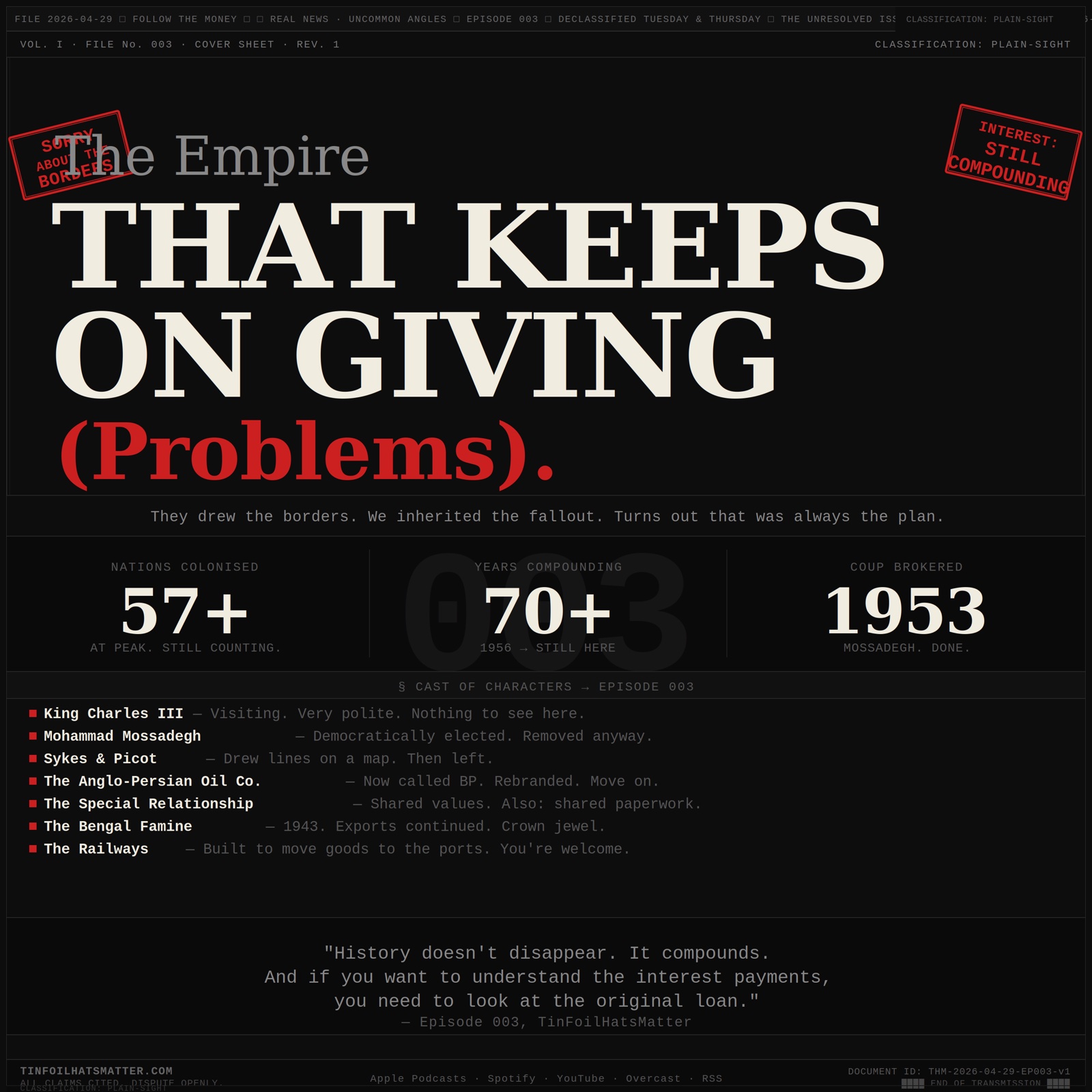
The Empire That Keeps on Giving (Problems)
King Charles is in Washington. We made a map. It's complicated.
King Charles III visits the United States just as America approaches its 250th independence anniversary — which makes it the perfect moment to ask how many of today's global crises trace directly back to the British Empire. From the Sykes-Picot Agreement to the 1953 Iranian coup to the Bengal Famine, this episode follows the paper trail from imperial decision to modern consequence. History doesn't disappear. It compounds.
Loading tally…
Cold open
So. King Charles III is in the United States this week.
Great timing. Nothing says "rock-solid international alliance" quite like two countries smiling politely at each other across a table that is absolutely buried in what I can only describe as several centuries of unresolved paperwork. Some of it is still warm. Nobody is looking at it. Everyone is very focused on the centerpiece.
And look — America is about to hit its 250th anniversary of independence. Which, if you need a quick refresher, was that deeply awkward breakup where we looked Britain dead in the eyes and said: "It's not you." Long pause. "Actually, it is completely you." Longer pause. "Stop taxing our tea, we're keeping the continent, we're writing an entire document about this, goodbye." And we did. We wrote the document. It's famous. And here we are, 250 years later, still having dinner together like nothing happened. Very mature. Very evolved. Very "we can still be friends."
Which raises what I think is a genuinely fair question — not a conspiracy, not a screed, just a question: how many of today's biggest global messes trace directly back to decisions made by the British Empire? Because I've been looking at this, and the answer is… a lot. It is a lot of messes. An uncomfortable number of messes. The kind of number that makes you want to go back and have a very different conversation about how the world got the way it is.
Welcome back to the show. Where we take the version of history everyone kind of agrees on, and then just… keep going. Past the comfortable part. Into the part where things start making sense in ways that are slightly inconvenient.
The Special Relationship
Let's start with the phrase of the moment: "The Special Relationship."
It sounds great. It sounds like an exclusive club with a very good dress code. In practice it's more like two countries standing in front of a truly massive mess, looking at each other, and agreeing — silently, over excellent wine, with very good posture — never to discuss out loud how the mess got there. Because the answer involves both of them. At different times. With different levels of direct responsibility. But consistently, reliably, both of them.
Because America didn't just appear. It inherited things. Infrastructure. Trade routes. Legal frameworks. Power structures. And — this is the key one — it inherited problems. Problems that came pre-installed. Problems with a return address that, if you followed it all the way back, ended somewhere in London.
The British Empire. The largest empire in human history at its peak. Which, honestly, respect. That is an extraordinary logistical achievement. It is also, when you start looking at the downstream consequences, kind of a horror show. Because the business model was simple to the point of being almost elegant:
- You show up.
- You claim the land.
- You extract the value.
- You install an administrative structure that works great for you and fine-to-terrible for everyone else.
- Eventually you leave — but you don't leave nothing. You leave behind borders, institutions, economic arrangements. All of it designed to serve the empire. None of it designed to serve the people who actually have to live there after you go.
And then those people have to figure out what to do with all of it. And sometimes they do. And sometimes it goes very badly. And either way, by that point, you're gone.
Borders, drawn over wine
Let's talk about borders, because this is where things get almost comedic — if the consequences weren't so serious.
The British Empire was extraordinarily confident about drawing lines on maps. Just — very comfortable with a pen. Very decisive. Lines that were clean and straight and organized and had essentially nothing to do with the people, cultures, languages, or tribal structures that had existed in those places for hundreds, sometimes thousands of years. But they looked great on paper. Very tidy. Very — and I want to use this word intentionally — European.
The most famous example is the Sykes-Picot Agreement. 1916. World War One is happening. Britain and France sit down and say, essentially: let's divide the Middle East between us. Mark Sykes on the British side. François Georges-Picot on the French side. A map. A pen. Zero meaningful input from anyone actually living in the region. No serious engagement with the tribal structures or religious communities or political relationships that had defined that part of the world for centuries.
What they produced was a set of borders that cut directly through communities, separated people who had been unified, and threw together people who had real, deep, fundamental disagreements with each other — all because it was convenient for British and French strategic interests at that particular moment in time.
Those borders, in various forms, are still there.
And when people talk about Middle Eastern instability like it's some kind of ancient, inscrutable, inherent cultural problem — it is worth noting, calmly, that some of the instability was specifically manufactured in 1916 by two men with a map and very little local knowledge. That's not an excuse for everything that's happened since. But it is a fact. A fact that tends to get quietly left out of a lot of conversations.
Iran, oil, and Operation Boot
Now. Iran. And oil. And a story that — regular listeners, this is your callback moment — we introduced in Episode 1 when we talked about the Anglo-Persian Oil Company. We touched on it. We laid the foundation. Today we are building the house, because this story deserves the full treatment.
The Anglo-Persian Oil Company. Founded in 1908 after oil was discovered in Iran. The British government took a majority stake in it during World War One because they understood that oil was going to matter, a lot, and they wanted control of it. The company later became the Anglo-Iranian Oil Company, and then British Petroleum, and then BP — because apparently the rebrand strategy is: if you change the name enough times, the history becomes harder to search for. I respect the hustle. I just don't respect what the hustle was in service of.
For decades, this company extracted Iranian oil under terms that were, to put it as generously as I can manage, not great for Iran. Iran got a royalty. Britain got the profits, the strategic leverage, and the control.
By the late 1940s there was enormous public pressure in Iran to renegotiate. And then in 1951, Mohammad Mossadegh became Prime Minister.
Democratically elected. Genuinely popular. Absolutely determined to nationalize Iran's oil industry — meaning Iran would control Iran's oil. Which is, when you say it out loud, not a radical concept. It is the concept of a country having sovereignty over its own natural resources. Iran's parliament voted for it. Mossadegh signed it. The Iranian public celebrated.
Britain was not celebrating. Britain immediately launched an international campaign to isolate Iran economically, organized a global boycott of Iranian oil, froze Iranian assets, and started having very serious conversations with the United States about whether something could be done about this Mossadegh situation. The Truman administration wasn't interested. Then the Eisenhower administration came in, the pitch got reframed around Cold War fears — the Soviet Union, communist influence, the usual — and suddenly the CIA and British intelligence were in business together.
The operation was called AJAX on the American side. On the British side it was called BOOT.
Boot. They named it Boot.
I just want to sit with that for a second. The covert operation to remove a democratically elected leader was called Boot. I don't know if that's confidence or just a complete lack of self-awareness, but either way, there it is.
Mossadegh is removed in a coup. He's arrested, tried for treason, spends the rest of his life under house arrest. The Shah is reinstalled with substantially expanded powers. Short-term stability: achieved. Oil flows: resumed. Long-term consequences: absolutely deferred, to be dealt with by someone else at a later date.
That later date was 1979.
The Iranian Revolution. The Shah falls. The Islamic Republic is established. And the United States — which had spent 26 years propping up the regime that the Iranian public just overthrew — suddenly finds itself with a hostage crisis, a broken relationship, and several decades of compounding tension that we are, right now in 2026, still actively trying to manage.
So when Britain raises concerns today about whether US actions involving Iran are legal — and look, those are legitimate concerns, international law is important, this is not a throwaway issue — there is a specific flavor of irony in the country that designed the removal of a democratic government now citing legal frameworks to govern how we handle the fallout from that removal.
Not hypocrisy exactly. Countries change. Standards evolve. You can hold yourself to a higher standard than you used to. But the history doesn't just disappear because your standards improved. It's still there. Under the table. Next to all the paperwork nobody is looking at.
The crown jewel: India
Let's do India, because we really can't not.
"Crown jewel of the empire." That's the actual phrase that was used. Crown jewel.
It is a remarkable branding choice for a relationship that was, economically speaking, one of the most sustained extractions of wealth from one region to another in human history. Economists who've studied this — seriously, peer-reviewed, this is not internet conspiracy stuff — have put figures on what left India during British rule, and the numbers run into what would be tens of trillions of dollars in modern terms.
The mechanism was relatively elegant, as extraction mechanisms go: India was required to export goods but was paid in its own tax revenues rather than in currency it could actually use elsewhere, which meant the wealth circulated in ways that consistently benefited British industry and consistently left Indian industry underdeveloped. It's the kind of system that, if you explained it now, you would get a lot of very uncomfortable looks in a lot of board rooms.
And then there are the famines.
Because it wasn't just economic. Under British rule, India experienced a series of devastating famines. The Bengal Famine of 1943 — 1943, within living memory, not ancient history — killed somewhere between two and three million people by conservative estimates. Churchill's wartime policies, his documented personal attitudes toward Indians and Indian suffering, the decisions to maintain exports and allocate resources away from famine relief — these are all part of that story. Historians argue about the precise weight of different factors. They do not seriously argue that the policy responses were adequate, or that imperial priorities didn't take precedence over Indian lives, because the record on that is pretty clear.
But — and this is always where we land — there were railways.
Britain built railways in India, and this gets cited regularly as evidence of the developmental benefits of empire. What is slightly less often mentioned is that those railways were built primarily to move goods from the interior to the ports, so they could be shipped to Britain. They were, in other words, extraction infrastructure. Useful! India has continued to use them, expanded them, built on them. But a gift it was not. It was a business decision. Let's not confuse the two.
Compounding interest
Here's what I keep coming back to with all of this: none of it is actually that long ago.
| Event | Year |
|---|---|
| Sykes-Picot Agreement | 1916 |
| Bengal Famine | 1943 |
| Partition of India and Pakistan | 1947 |
| Iranian coup (Operation Ajax / Boot) | 1953 |
These are not medieval events. These are things that happened to people who are still alive, or to their parents, or to their grandparents. The consequences aren't theoretical. They're structural. They're in the political geography of the modern world. They're in the tensions we're currently trying to manage. They're in the conversations happening right now, this week, during a state visit where everyone is very focused on the shared future and very carefully not looking at the shared past.
And this is what makes the current moment genuinely interesting to me. Because the Special Relationship, as it's being talked about right now, is framed around shared values. Common interests. Mutual commitment to stability and democracy and the rules-based international order. All of which are real things. All of which matter. I'm not dismissing any of that.
I'm just pointing out that those things exist in a context. A context that includes the fact that some of the instability this alliance is currently trying to manage was created by this alliance. Or by the structures that preceded it and that it inherited and, in many cases, continued. The problems didn't come from nowhere. They came from decisions. Decisions that, at the time, made perfect sense to the people making them — because the interests of the people who would bear the consequences were either not considered, or considered and dismissed, or considered and actively suppressed. And that part compounds.
Compounding is the key word here. Because interest compounds in both directions. Good decisions build into stability and prosperity over time. Bad ones build into instability and conflict. And the further you get from the original decision, the harder it is to trace the line back — which is very convenient if you were the one who made the decision, and significantly less convenient if you're the one currently living with the consequences of it.
The modern world is not random. I want to say that clearly. It is not a collection of inexplicable crises that emerged because some regions are just inherently chaotic, or some cultures are just like that, or some people simply cannot get it together. Every conflict, every tension, every situation that gets described by foreign policy analysts as "uniquely complex with deeply entrenched historical roots" has an actual history. With actual decisions. Made by actual people. Often with a pen. Often over a map. Often very far from the place they were drawing lines on.
That doesn't let anyone off the hook for their own choices. It doesn't mean current governments can point at 1953 and call it a day. It doesn't mean historical grievance is a blank check. But it does mean that when we talk about these situations as though they materialized from nothing — as though the Middle East just spontaneously developed its current borders, as though Iran just randomly decided to distrust Western powers, as though post-colonial instability is a mystery without an explanation — we are being, at minimum, intellectually dishonest. And at maximum, we are making the exact same mistake the empire made, which is treating the people affected by these decisions as background characters in a story that's really about us.
The close
So. King Charles III. Washington. Flags. State dinner. Very good posture from everyone involved.
The alliance is real. The partnership matters. The photo ops will be excellent. None of that is false.
But the most honest version of the Special Relationship — the version that might actually be useful going forward — is one that includes the full history. Not as a guilt exercise. Not to relitigate who owes whom an apology for what. But because you genuinely cannot understand why the world looks the way it does right now without understanding how it got there. And the countries currently sitting at the table deciding what to do about it are, not coincidentally, the same countries that did a significant amount of the shaping.
History doesn't disappear. It compounds.
And if you want to understand the interest payments, you need to go back and look at the original loan.
Full source list and citations in the dead drop newsletter.