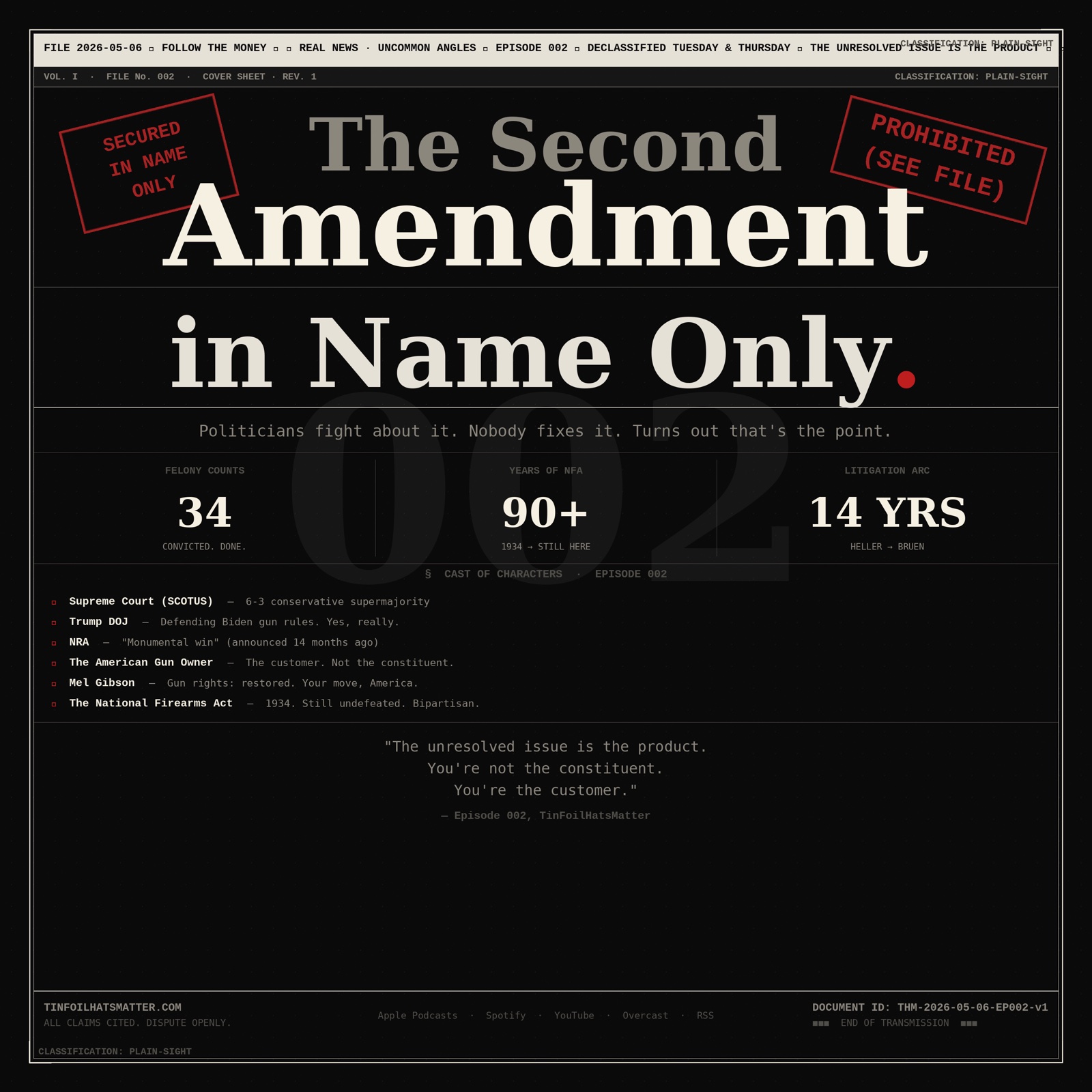
The Second Amendment in Name Only
The Right Under Permanent Siege — By Design
The Supreme Court has spent seventeen years firmly establishing the Second Amendment as an individual right — and politicians have spent every one of those years raising money off the threat that it might disappear. This episode traces the actual paper trail: landmark cases, executive orders, and the quietly remarkable fact that the Trump DOJ spent 2025 defending Biden-era gun regulations in federal court while the president himself is legally prohibited from owning a firearm. The unresolved issue, it turns out, is the product — and you're not the constituent, you're the customer.
Loading tally…
Cold open
Alright, let's talk about the Second Amendment. Or more specifically, let's talk about how politicians talk about the Second Amendment — which is, as we'll see, a very different thing.
Here's a little trick I want you to try. Next time you're watching political coverage, don't pay attention to what politicians are fighting about. Pay attention to what they never actually fix. Because some issues are just... too good to solve. They raise money. They terrify people. They get butts in seats on Election Day. And nothing — nothing — works better for that than telling your base that the other side is coming for their guns.
It's a beautiful system. If you squint at it from a purely cynical angle.
What the Court actually said
So let's ground this in what the Supreme Court has actually said — because this part is genuinely interesting, and I promise I'll try to be only mildly sarcastic.
Heller, 2008. The Court finally settled it: the Second Amendment protects an individual right. Not a collective militia right. An individual right. Justice Scalia wrote that "the inherent right of self-defense has been central to the Second Amendment right." And this is the part politicians never quote — he also wrote that "the enshrinement of constitutional rights necessarily takes certain policy choices off the table."
Off the table. Not "subject to popularity contests." Not "revisit every election cycle." Off the table.
McDonald, 2010. The right applies to the states too. Great.
Bruen, 2022. Justice Thomas said: we're done with interest-balancing. You don't get to say "well, public safety is really important" and call that a legal argument. Now you have to show your gun regulation is consistent with historical tradition going back to the founding era. States responded to this by immediately drafting new laws, expanding "sensitive places," and piling on procedural layers, because of course they did. Litigation is ongoing. Shocking.
Rahimi, 2024. The Court upheld the federal prohibition on gun possession by people under domestic violence restraining orders. The Court held that an individual found by a court to pose a credible threat to someone's physical safety may be temporarily disarmed consistent with the Second Amendment. Eight to one. Even with the new historical test, that one wasn't particularly close.
And then there's Garland v. Cargill, also 2024. You remember bump stocks — the accessory the Trump administration banned via ATF rulemaking after the Las Vegas massacre. The Court said, politely in legal language, that the ATF just... made that up. A bump stock does not convert a rifle into a "machinegun" for the purposes of federal gun control laws. The ban was thrown out.
Which is fine on the statutory merits. But let's just note: the same administration that campaigns as the last line of defense for your gun rights used a regulatory agency to ban a gun accessory. Then a different administration had to fight to overturn it in court. Institutionalism is a heck of a drug.
2025 — Trump's DOJ defends Biden's ghost gun rule
Now 2025. Bondi v. VanDerStok. Ghost guns — firearms assembled from parts kits, no serial number, no background check, fully untraceable. The Biden ATF issued a rule saying these kits count as firearms under the Gun Control Act. Gun rights groups sued.
And here's where it gets interesting. By a vote of 7 to 2, the Supreme Court upheld the rule, with Justice Gorsuch writing the majority opinion — the same Gorsuch who was put on the Court to protect gun rights, joined by Kavanaugh and Barrett, both Trump appointees. The Trump administration, which had been making considerable noise about rolling back Biden-era gun rules, did not move to revoke the ghost gun rule before the case was decided, and ended up defending it in court.
That's right. The Trump DOJ defended a Biden ATF gun regulation before the Supreme Court.
Only Thomas and Alito dissented. So if you're keeping score at home: the most significant gun regulation victory of 2025 was written by a Republican-appointed justice, joined by two Trump justices, and defended by the Trump administration.
You want to talk about your brand not matching your behavior — we can do that.
A year later: the brand vs. the behavior
And speaking of brands not matching behavior — let's talk about Trump's February 2025 executive order, grandly titled "Protecting Second Amendment Rights." The order directed the Attorney General to conduct a sweeping review of all Biden-era firearms regulations and deliver a plan to eliminate what it called "infringements" on Second Amendment rights. The NRA called it a "monumental win." Gun owners celebrated.
That was over a year ago.
A year later, gun rights advocates say the administration has fallen short — even as it has challenged some state gun laws, it is also defending long-standing federal gun restrictions in court. Including the law banning drug users from possessing firearms — which, by the way, is the same law that Hunter Biden was convicted under. The Trump DOJ is currently defending it before the Supreme Court.
The bit that writes itself
And here is the part I genuinely cannot believe I get to say out loud on a podcast.
Because Trump is a convicted felon, he is legally barred under federal law from possessing firearms or ammunition. It is unclear whether the president has surrendered all of his firearms.
The man who signed an executive order protecting your Second Amendment rights cannot legally own a gun.
Let me say that again, slowly, because I want you to really absorb it.
The President of the United States — who ran on gun rights, who the NRA endorsed, who told crowds he was the greatest defender of the Second Amendment in American history — is, under the very federal law his own Justice Department is currently defending before the Supreme Court, prohibited from owning a firearm.
And it's not even a close call. 34 felony counts. Convicted. Done.
Now to be fair — and I am being extremely generous here — his legal team has argued the conviction was improper, politically motivated, all of that. Maybe you believe that, maybe you don't. But the law doesn't have a "probably shouldn't count" exception. The law that the Trump DOJ is standing up in court right now applies to Donald Trump. Full stop.
And look, there's a version of this that's actually intellectually coherent. Trump could say: "This is exactly why I'm fighting to reform felon-in-possession laws — because I know firsthand how the system can be weaponized." That would be a consistent position. That would at least be something.
Instead, his administration is defending the felon gun ban in court while the president himself has claimed, on the campaign trail, that he owns guns. Which, again, is illegal. For him. Specifically.
I don't know how you write this as a bit. It's already a bit.
Restorations: the case-by-case carveout
Now there is some genuine movement worth noting. The DOJ proposed a rule that would restore gun rights to individuals with criminal convictions who are not "likely to act in a manner dangerous to public safety," on a case-by-case basis. That's arguably overdue — plenty of people with old, nonviolent convictions have been permanently stripped of a constitutional right with no path to restore it.
The program has already had at least one notable beneficiary: Mel Gibson, whose domestic violence conviction had barred him from owning firearms.
So that's where we are. The president can't own guns. Mel Gibson can again.
America.
The most popular rifle in America, legally undefined
Now let's talk about the AR-15 — the most popular civilian rifle in the country, with tens of millions in circulation — because its legal status remains entirely unresolved at the Supreme Court. Which, when you think about it, is remarkable.
The Court has weighed in on handguns. On bump stocks. On domestic abusers. On ghost guns assembled in basements from kits with names like "Buy Build Shoot." And yet the single most culturally, politically, and legally contested firearm in the country? We're still waiting.
The Court denied cert on Maryland's AR-15 ban in June 2025, with Thomas, Alito, and Gorsuch saying they would have taken the case. Kavanaugh wrote separately — he didn't vote to take it, but made clear he doubted the Fourth Circuit was right to uphold the ban, and the Court "should and presumably will" address the AR-15 issue "in the next Term or two."
"The next term or two."
That statement was made in June 2025. So we're talking, conservatively, 2026 or 2027 before we get a ruling on whether the government can ban the most commonly owned rifle in the country.
Meanwhile Maryland's ban stays in effect. California's ban stays in effect. Illinois's ban stays in effect. Residents in those states are living under laws that three sitting Supreme Court justices already think are unconstitutional, and the Court's answer is essentially: we'll circle back.
I understand the reasoning. There's a circuit split developing, other cases are percolating, they want a cleaner vehicle. That's all legally sensible. But step outside the legal logic for a second and just appreciate the situation: courts are currently divided on whether the Second Amendment protects the most popular rifle in America. Some circuits say yes. Some say no. Americans in different states are living under completely opposite legal realities while the Court finishes its paperwork.
That is the litigation-first strategy in action. It works. Eventually. Slowly. And while it's working its way through the system, states keep enforcing the laws being challenged, and politicians keep telling you they're fighting for you.
The asymmetry
Which brings me to the part that should genuinely bother you regardless of where you stand — and I say that knowing full well "here's something that should bother everyone" is the most naive sentence in political commentary. But bear with me.
There is a fundamental structural asymmetry in how gun regulations get added versus how they get removed.
| Direction | Mechanism | Time |
|---|---|---|
| Adding a regulation | Agency memo / ATF rule | Days to weeks |
| Removing a regulation | Litigation through federal courts | Years to a decade |
Regulations move through administrative action. An agency decides bump stocks are machine guns — done. An agency rewrites the definition of "firearm" to include ghost gun kits — done. An agency issues "zero tolerance" enforcement guidance that results in a near six-fold increase in license revocations of firearms dealers — that happened under the Biden administration, and the Trump ATF replaced the policy in May 2025. Fine. But it took a whole new administration and several months to undo what one policy memo created.
Expanding gun rights, by contrast, requires either legislation — which means 60 votes in the Senate, a House majority, and a willing president — or it requires winning in federal court. And winning in federal court means filing suit, surviving a motion to dismiss, going through discovery, getting a ruling, surviving the appeal, potentially going to the Supreme Court, and then — if you win — waiting for the mandate to issue while the other side files for a stay. We are talking years. Sometimes a decade.
Heller was decided in 2008. McDonald in 2010. Bruen in 2022. These aren't just cases — they're a fourteen-year arc of litigation to establish rights that, according to the Court, were in the Constitution the whole time.
During those fourteen years, the challenged laws stayed on the books. People lived under them. People were prosecuted under them. And politicians collected donations to "fight for" rights that courts were slowly, painstakingly restoring.
That's not a conspiracy. That's just what happens when one side can act with a memo and the other has to win in court. Friction favors the status quo. And the status quo in most jurisdictions is more regulation, not less.
So when you hear a politician talk about "protecting" your Second Amendment rights, the question to ask is: protecting them how? Because there's protection that means filing an amicus brief and issuing a press release, and there's protection that means passing a statute that doesn't require you to win the lottery of Supreme Court cert grants every decade just to keep the right functional.
Those are very different things. Only one of them involves actual work.
The unresolved issue is the product
Which brings us back to the gap between rhetoric and resolution. Unified Republican control from 2017 to 2019 — no NFA repeal, no national reciprocity signed into law, bump stocks banned administratively. Trump's second term — a big executive order, some ATF policy tweaks, a proposed rule to restore some gun rights, and the DOJ defending a Biden-era ghost gun regulation in front of the Supreme Court — while gun rights groups publicly say the record has been "very mixed."
Ask them for the bill number. Ask them what they did with unified control. Ask why the National Firearms Act — passed in 1934, the year Bonnie and Clyde died — has been defended in federal court by every administration, Republican and Democrat, for ninety years without anyone seriously moving to repeal it.
Watch how fast they change the subject.
The close
Here's what I actually think is true, and I'll try to say it without too much spin:
The Second Amendment is a real right. The Court has said so, repeatedly, emphatically, and with increasingly strong language. And the people who want it genuinely secured — not performed, not fundraised around, but secured — are largely getting strung along by a political class that has figured out the right is more valuable as a threat than as a settled question.
A settled question generates nothing. A right under permanent siege generates billions of dollars, millions of votes, and decades of career security for people who have every incentive to keep the fight going and no incentive whatsoever to finish it.
That's the game. And it's not unique to this issue — it's the same game played with immigration, with healthcare, with a dozen other things that have been "about to be resolved" for thirty years.
The unresolved issue is the product.
You're not the constituent.
You're the customer.
So I'll leave you with this. The Court has now said, clearly, that constitutional rights cannot be treated as optional based on their popularity. That the government cannot simply assert an important interest and call it a day. That agencies cannot rewrite statutes to suit their own preferences. Those are strong principles. The right ones.
The question is whether the politicians you're voting for actually believe them — or whether they just need you to believe that they believe them.
Which is a different thing entirely.
And considerably cheaper to produce.
Full source list and citations in the dead drop newsletter.